Indoor Fun Checklist for Kids: Easy Ideas for All Ages
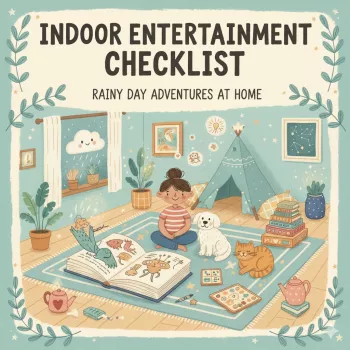
Indoor Entertainment Checklist for Kids: Simple Ideas That Keep Every Age Busy Indoors
When the weather, schedules, or energy levels keep everyone inside, a ready-to-go checklist makes it easier to offer choices without turning the day into a negotiation. Use a mix of movement, creativity, quiet time, and small responsibilities to keep kids engaged and reduce “I’m bored” moments.
How a checklist turns indoor time into smoother days
A simple indoor entertainment checklist works like a friendly “menu” for the day. Instead of inventing ideas on the spot (and getting stuck in endless back-and-forth), you can point kids toward a short list of options they already like.
- Reduces decision fatigue by offering a short menu of kid-approved options
- Balances high-energy activities with calm resets to prevent spirals
- Encourages independence: kids can pick, prep, and complete activities with less prompting
- Supports different ages at once by grouping activities by effort level and supervision needs
- Creates quick wins on tough days (rainy afternoons, sick days, school breaks)
For a one-page option that’s ready to print, try the Indoor Entertainment Checklist for Kids (printable digital download) and keep it on the fridge or in a travel folder.
A simple indoor rhythm: move, make, focus, help, rest
When indoor time starts feeling chaotic, the fix usually isn’t “more activities”—it’s a better flow. A predictable rhythm helps kids switch gears without meltdowns, and it gives you a clear next step.
- Move: Start with a 10-minute movement burst (dance party, hallway relay, yoga cards) to reset attention. The CDC notes that regular physical activity supports overall health and wellbeing for kids—short bursts indoors still count. (CDC: Physical Activity Basics)
- Make: Follow with a “make something” block (art, building, pretend play) for 20–40 minutes.
- Focus: Add a focus block (puzzles, audiobooks, STEM kits, simple board games) for calmer engagement.
- Help: Include a helping block (sorting laundry, wiping baseboards, setting the table) to channel energy productively.
- Rest: Close with a rest block (cozy corner, reading, sensory bin, quiet music) to prevent end-of-day meltdowns.
If screens are part of your routine, keep them intentional and time-boxed. The American Academy of Pediatrics highlights how young children benefit most from mindful media use with clear limits and adult involvement. (American Academy of Pediatrics: Media and Young Minds)
Pick-by-age activity ideas (toddlers to big kids)
The fastest way to keep multiple ages busy is to match the activity to (1) attention span and (2) how much setup you can handle that day. Use these as plug-and-play options, then repeat favorites with small twists.
- Toddlers (1–3): water painting with a brush and a bowl, sticker collages, animal walks, “find the color” scavenger hunt
- Preschool (3–5): pretend restaurant, simple obstacle course, playdough bakery, magnet letters sorting, bingo with pictures
- Early elementary (6–8): LEGO challenge cards, mini science demos (sink/float), comic strip drawing, card games, beginner coding apps with timers
- Older kids (9–12): room redesign on paper, stop-motion video with toys, cooking/baking helper tasks, strategy games, DIY craft kits
- All ages together: karaoke, pillow fort reading, family talent show, indoor camping, story-building where each person adds a sentence
Quick indoor activity planner by age
| Age range | Low-prep ideas | Best for | Typical time | Supervision |
|---|---|---|---|---|
| 1–3 | Sticker page, sensory bin (dry pasta), bubble wrap stomp | Sensory + movement | 5–20 min | High |
| 3–5 | Obstacle course, playdough prompts, matching games | Imagination + motor skills | 15–40 min | Medium |
| 6–8 | Building challenge, scavenger hunt clues, simple science | Problem-solving | 20–60 min | Low–Medium |
| 9–12 | Stop-motion, board games, DIY kits, journaling prompts | Longer projects | 30–90 min | Low |
Set up an “indoor fun shelf” so activities start fast
Indoor entertainment works best when the start is easy. If kids need you to hunt for supplies every time, the activity becomes a whole event. A dedicated shelf (or a closet corner) removes friction.
For a tidy, easy-to-reset supply station, the 3-Layer Drawer Desktop Makeup Organizer – Dustproof Storage Box can work well for markers, stickers, dice, and small craft extras.
Keeping kids engaged without constant supervision
The goal isn’t to fill every minute—it’s to help kids practice starting and finishing something. That “I can do this” momentum supports self-regulation and planning skills that build over time. (Harvard Center on the Developing Child: Executive Function & Self-Regulation)
Printable checklist: what to look for in a kid-friendly digital download
A ready-made option to print and use today
Pair indoor play with a smoother start to the day using the Preschool Drop-Off Survival Checklist (printable morning routine guide), especially during school breaks or schedule changes.
FAQ
What are good indoor activities for different ages at the same time?
Try mixed-age activities with built-in roles: scavenger hunts with easier and harder clues, building challenges where older kids “design” and younger kids “test,” indoor camping, talent shows, and group story games where each person adds a sentence. Giving older kids helper jobs (timer captain, materials manager, clue reader) keeps things fair and reduces arguments.
How can indoor activities stay fun without buying new supplies?
Rotate what you already own, add simple challenge prompts, and use a timer to make familiar activities feel fresh. Tape-and-paper engineering, card games, DIY obstacle courses, and “build the tallest tower” challenges can be repeated endlessly with small rule changes.
How many activities should be on an indoor checklist?
Aim for 15–30 total ideas across categories, then highlight 5–8 favorites that reliably work for your kids. A shorter, well-chosen list feels easier to start and prevents kids from getting overwhelmed by too many options.








Leave a comment